Driving Test Questions Pakistan – 50 MCQs, Road Signs & Practice Test (2026)
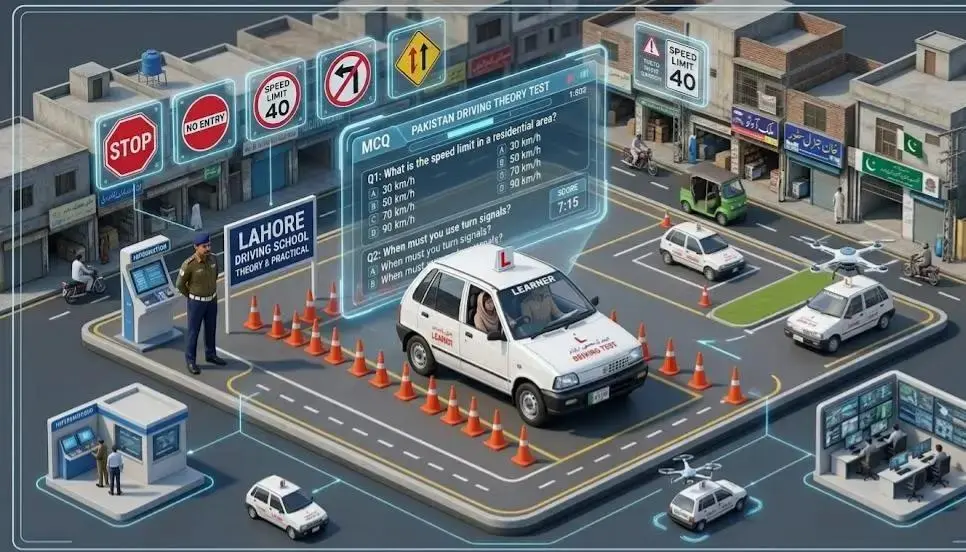
Passing a driving license test in Pakistan requires both practical driving skills and a strong understanding of theory. Many applicants focus only on driving but fail because they are not prepared for driving test questions.
With the introduction of digital systems like the Driving License Issuance Management System (DLIMS), the process now includes a structured computer-based theory test followed by a practical exam.
This guide will help you prepare for driving test questions Pakistan, including 50 MCQs, road signs, and effective strategies to pass on your first attempt.
For complete guides and updates, you can visit Drive Guide Hub where all DLIMS-related resources are explained.
Understanding the Driving Test in Pakistan
Before appearing in the driving test, you must first apply for a learner permit. Follow our complete guide on Apply Learner License Pakistan Online to get started.
The driving license test in Pakistan is divided into two main parts:
Theory Test (MCQs)
- Computerized test of 20–25 questions
- Questions based on traffic signs, road rules, and safety
- Must score at least 70–80% to pass before the practical test
Practical Driving Test
- Reverse parking
- L-shape or track driving
- Vehicle control and awareness
According to official guidelines, the theory test evaluates knowledge of traffic signs, road safety rules, and driving ethics.
Types of Driving Test Questions
To succeed, you must understand the different types of questions that appear in the test.
Traffic Signs Questions
These questions test your ability to recognize and understand road signs. Traffic signs are a compulsory part of the theory test — failing the signs section means you cannot proceed further. You must be able to identify signs by shape, color, and meaning without reading a label.
Traffic Rules Questions
These questions focus on laws and regulations — when to use indicators, right of way rules, speed limits on different road types, and legal driving age requirements. The minimum age for a car driving license in Pakistan is 18 years.
Situational Driving Questions
These are real-life scenarios: what to do at intersections, when overtaking is allowed, how to handle a breakdown on the motorway, and what to do when a traffic signal is not working. These are the hardest questions for most applicants.
50 Pakistan Driving Test Practice MCQs (2026)
Practice all 50 questions below. The actual DLIMS theory test has 20–25 questions — aim to score 100% here consistently before booking your test.
Section 1: Traffic Signs (Questions 1–15)
Q1: What should you do at a red traffic light? A) Go B) Slow down C) Stop D) Sound horn ✅ Correct Answer: C — Stop
Q2: What does a “No Entry” sign mean? A) Parking allowed B) Entry prohibited C) Slow down D) One-way road ahead ✅ Correct Answer: B — Entry prohibited
Q3: What does a yellow/amber traffic light mean? A) Go faster B) Stop immediately C) Prepare to stop D) Reverse ✅ Correct Answer: C — Prepare to stop
Q4: What shape is a WARNING sign in Pakistan? A) Circle B) Rectangle C) Triangle D) Octagon ✅ Correct Answer: C — Triangle
Q5: What does a STOP sign look like? A) Yellow triangle B) Red octagon with white STOP text C) Blue circle D) White rectangle ✅ Correct Answer: B — Red octagon with white STOP text
Q6: What does a “Give Way” sign mean? A) You have priority B) Stop completely C) Slow down and give priority to other vehicles D) Road closed ✅ Correct Answer: C — Slow down and give priority to other vehicles
Q7: A sign showing a child walking means: A) Playground area B) School zone — drive carefully C) No pedestrians allowed D) Pedestrian crossing ahead ✅ Correct Answer: B — School zone — drive carefully
Q8: What does a circular sign with a red border generally indicate? A) Information B) Warning C) Prohibition or restriction D) Direction ✅ Correct Answer: C — Prohibition or restriction
Q9: What does a “No Overtaking” sign look like? A) Red triangle with two cars B) Circle with two cars and a red line through them C) Yellow square with an arrow D) Blue rectangle ✅ Correct Answer: B — Circle with two cars and a red line through them
Q10: A blue rectangular sign generally means: A) Warning B) Prohibition C) Information or direction D) Priority road ✅ Correct Answer: C — Information or direction
Q11: What does a “U-Turn Prohibited” sign mean? A) You must make a U-turn B) U-turns are not allowed at this point C) Road is one-way D) No parking ✅ Correct Answer: B — U-turns are not allowed at this point
Q12: What does a speed limit sign with “50” inside a red circle mean? A) Minimum speed is 50 km/h B) Maximum speed is 50 km/h C) Average speed is 50 km/h D) Speed limit ends at 50 km/h ✅ Correct Answer: B — Maximum speed is 50 km/h
Q13: What does a white horizontal bar inside a red circle mean? A) No entry for all vehicles B) Stop sign C) Speed limit D) No parking ✅ Correct Answer: A — No entry for all vehicles
Q14: A sign showing a petrol pump symbol means: A) No fuel vehicles allowed B) Fuel station ahead C) Car repair shop D) Parking for vehicles only ✅ Correct Answer: B — Fuel station ahead
Q15: What does a “Pedestrian Crossing” sign tell a driver? A) No pedestrians allowed B) Slow down — pedestrians may be crossing C) Honk to warn pedestrians D) Road closed ✅ Correct Answer: B — Slow down — pedestrians may be crossing
Section 2: Road Rules & Traffic Laws (Questions 16–30)
Q16: What is the minimum driving age for a car license in Pakistan? A) 16 years B) 17 years C) 18 years D) 21 years ✅ Correct Answer: C — 18 years
Q17: What should you use before turning left or right? A) Horn B) Brake C) Indicator/turn signal D) Headlights ✅ Correct Answer: C — Indicator/turn signal
Q18: Why is a seat belt important? A) It is required by law and protects you in a crash B) It keeps you warm C) It is only for front-seat passengers. D) It is optional on slow roads ✅ Correct Answer: A — It is required by law and protects you in a crash
Q19: When should you use your headlights? A) Only at night B) At night, in fog, and in heavy rain C) Only in tunnels D) Only when requested by police ✅ Correct Answer: B — At night, in fog, and in heavy rain
Q20: What is the speed limit on Pakistan motorways for cars? A) 80 km/h B) 100 km/h C) 120 km/h D) 140 km/h ✅ Correct Answer: C — 120 km/h
Q21: What is the speed limit in a residential area unless otherwise posted? A) 40 km/h B) 50 km/h C) 60 km/h D) 80 km/h ✅ Correct Answer: B — 50 km/h
Q22: Who has the right of way at an unmarked intersection? A) The vehicle on the left B) The vehicle on the right C) The larger vehicle D) The faster vehicle ✅ Correct Answer: B — The vehicle on the right
Q23: When is overtaking prohibited? A) On straight roads B) Near bends, hills, pedestrian crossings, and intersections C) During daytime only D) Only on motorways ✅ Correct Answer: B — Near bends, hills, pedestrian crossings, and intersections
Q24: How far should you park from a fire hydrant? A) 3 metres B) 5 metres C) 10 metres D) No restriction ✅ Correct Answer: B — 5 metres
Q25: What must you do when an ambulance with siren is approaching? A) Speed up to clear the road B) Ignore it C) Move to the side and let it pass D) Stop in the middle of the road ✅ Correct Answer: C — Move to the side and let it pass
Q26: Using a mobile phone while driving (without hands-free) is: A) Allowed at slow speeds B) Illegal and can result in a fine C) Only illegal on motorways D) Allowed if using speaker mode ✅ Correct Answer: B — Illegal and can result in a fine
Q27: You must stop and give way to pedestrians: A) Only when they wave at you B) Only at traffic lights C) At all marked pedestrian crossings D) Only in school zones ✅ Correct Answer: C — At all marked pedestrian crossings
Q28: What does “double yellow lines” painted on the road mean? A) Parking allowed at night B) No parking or stopping at any time C) Short-term parking only D) Loading zone ✅ Correct Answer: B — No parking or stopping at any time
Q29: Before reversing your vehicle, you must: A) Sound the horn and check all mirrors and blind spots B) Just look in the rear view mirror C) Ask someone to stand behind the car D) Reverse quickly to avoid traffic ✅ Correct Answer: A — Sound the horn and check all mirrors and blind spots
Q30: What is the blood alcohol limit for drivers in Pakistan? A) 0.05% B) 0.08% C) Zero — alcohol is completely prohibited D) 0.03% ✅ Correct Answer: C — Zero — alcohol is completely prohibited under law
Section 3: Situational Driving (Questions 31–40)
Q31: The traffic signal is not working at an intersection. What should you do? A) Drive through quickly B) Treat it as a four-way stop — slow down and proceed carefully C) Only vehicles on the main road have right of way D) Wait indefinitely ✅ Correct Answer: B — Treat it as a four-way stop
Q32: Your vehicle breaks down on the motorway. What is the first thing to do? A) Get out and stand in the lane B) Call a friend C) Move to the emergency lane, switch on hazard lights D) Try to fix it in the driving lane ✅ Correct Answer: C — Move to the emergency lane, switch on hazard lights
Q33: It is raining heavily. You should: A) Drive at the same speed B) Speed up to get off the road faster C) Reduce speed, increase following distance, turn on headlights D) Use full beam headlights ✅ Correct Answer: C — Reduce speed, increase following distance, turn on headlights
Q34: A vehicle ahead suddenly brakes. The safest reaction is: A) Swerve immediately into the next lane B) Apply brakes firmly and check mirrors C) Sound horn and overtake D) Accelerate to pass before they stop ✅ Correct Answer: B — Apply brakes firmly and check mirrors
Q35: You want to change lanes on a motorway. You should: A) Change quickly without warning B) Check mirrors, signal, check blind spot, then change gradually C) Sound horn before moving D) Only change lanes when no one is behind you ✅ Correct Answer: B — Check mirrors, signal, check blind spot, then change gradually
Q36: A child runs onto the road unexpectedly. You should: A) Sound horn loudly B) Swerve onto the pavement C) Brake immediately and firmly D) Flash headlights ✅ Correct Answer: C — Brake immediately and firmly
Q37: When approaching a roundabout, you must: A) Speed up to enter before others B) Give way to vehicles already in the roundabout C) Always stop completely D) Sound horn before entering ✅ Correct Answer: B — Give way to vehicles already in the roundabout
Q38: You are driving at night and there is oncoming traffic. You should use: A) Full/high beam headlights B) Hazard lights C) Low beam/dipped headlights D) No lights ✅ Correct Answer: C — Low beam/dipped headlights
Q39: Safe following distance from the vehicle ahead at 80 km/h is: A) 10 metres B) 20 metres C) At least 50 metres (the 2-second rule) D) 5 metres ✅ Correct Answer: C — At least 50 metres (use the 2-second rule)
Q40: A learner license holder must: A) Drive alone on all roads B) Practice under supervision of a licensed driver C) Only drive motorcycles D) Apply for a permanent license immediately ✅ Correct Answer: B — Practice under supervision of a licensed driver
Section 4: Speed Limits & Fines (Questions 41–45)
Q41: What is the general speed limit in a school zone? A) 60 km/h B) 50 km/h C) 25–30 km/h D) 40 km/h ✅ Correct Answer: C — 25–30 km/h (varies by province)
Q42: Driving without a valid license in Pakistan results in: A) A warning only B) A fine and possible vehicle impoundment C) No penalty for first offence D) Only a verbal warning from traffic police ✅ Correct Answer: B — A fine and possible vehicle impoundment
Q43: What is the speed limit on a national highway (non-motorway) for cars? A) 80 km/h B) 100 km/h C) 120 km/h D) 60 km/h ✅ Correct Answer: B — 100 km/h
Q44: Not wearing a seat belt in Pakistan results in: A) No penalty B) A traffic e-challan fine C) License suspension D) Vehicle confiscation ✅ Correct Answer: B — A traffic e-challan fine
Q45: Using a mobile phone while driving can result in: A) No penalty B) A verbal warning C) An e-challan fine D) Only a penalty if involved in an accident ✅ Correct Answer: C — An e-challan fine
Section 5: Vehicle Safety (Questions 46–50)
Q46: Before starting a long journey, you should check: A) Only fuel level B) Tyre pressure, fuel, brakes, mirrors, and lights C) Only the engine oil D) Nothing if the car drove fine yesterday ✅ Correct Answer: B — Tyre pressure, fuel, brakes, mirrors, and lights
Q47: Your brakes feel soft or “spongy” while driving. You should: A) Continue driving carefully B) Stop safely as soon as possible and get brakes checked C) Press harder on the brake pedal D) Only stop if brakes fail completely ✅ Correct Answer: B — Stop safely as soon as possible and get brakes checked
Q48: What does a red temperature warning light on your dashboard mean? A) Normal engine temperature B) Engine is overheating — stop immediately C) Air conditioning is on D) Fuel is low ✅ Correct Answer: B — Engine is overheating — stop immediately
Q49: Tyre pressure should be checked: A) Only when a tyre looks flat B) Regularly, at least once a month and before long trips C) Only at the mechanic D) Never — modern cars self-adjust ✅ Correct Answer: B — Regularly, at least once a month and before long trips
Q50: When parking on a hill facing downward, you should: A) Leave the car in neutral B) Turn wheels toward the curb and engage handbrake C) Leave wheels straight D) Only use the footbrake ✅ Correct Answer: B — Turn wheels toward the curb and engage handbrake
Driving Test Pattern in Pakistan (2026)
The test format is straightforward but requires preparation:
Theory Test
- Usually 20–25 MCQs on a computer screen
- Must score at least 70–80% (18 correct out of 25 at most centers)
- Based on traffic signs, road rules, and situational questions
- Complete all questions within the time limit — do not leave any blank
Practical Test
The practical exam is conducted at a designated driving track. Examiners check:
- Reverse parking — entering a marked bay in reverse
- L-shape or track driving — navigating a set course without hitting cones
- Indicator and mirror use — must signal before every turn
- Vehicle control — smooth clutch, braking, and acceleration
- Confidence — hesitation and repeated stalling may result in failure
How to Prepare for the Driving Test
Study traffic signs daily — Start with the 10 most-tested signs: Stop, No Entry, Give Way, Speed Limit, No Overtaking, U-Turn Prohibited, School Zone, Pedestrian Crossing, No Parking, and One Way. The official Punjab Traffic Police road signs PDF contains all signs used in the test. Spend 10 minutes each day recognizing signs without reading the label — this is exactly how the computerized test works.
Practice MCQs until you score 90%+ — The 50 questions on this page reflect the actual difficulty level of the DLIMS test. Aim to score at least 45/50 consistently before booking your test. Do not just read the answers — cover them and actually answer each question first.
Practice driving skills before the practical test — Focus on reverse parking and L-shape track driving specifically. These are the two most common reasons candidates fail. Practice in an empty car park before your test date.
Stay calm on test day — Nervousness causes the most failures. Arrive early, adjust your mirrors before starting, and drive at a slow, controlled pace. Examiners are not checking your speed — they are checking your habits.
Common Mistakes to Avoid
Many candidates fail due to avoidable errors:
- Not learning traffic signs before the theory test
- Forgetting to use indicators before turning in the practical
- Not checking mirrors before reversing
- Stalling the vehicle multiple times during the track test
- Rushing through the computerized MCQ test without reading each question carefully
Tips to Pass the Driving Test on Your First Attempt
- Use indicators before every turn — even on the test track
- Check all mirrors before reversing
- Drive slowly and smoothly — control matters more than speed
- Follow the examiner’s instructions exactly
- Practice the L-shape parking at least 20 times before test day
- Score 90%+ on the 50 MCQs above before sitting the theory test
Related Driving License Guides
- Apply Learner License Pakistan Online (DLIMS Guide 2026)
- Apply Driving License Online in Punjab (DLIMS 2026)
- Driving License Renewal Online Pakistan 2026 – DLIMS Process
FAQs
What are driving test questions in Pakistan? Driving test questions are MCQs based on traffic rules, road signs, and safe driving practices. These are part of the computerized theory test conducted through the DLIMS system at licensed traffic police centers.
How many questions are in the driving test? Usually the test includes 20–25 MCQs. You must achieve passing marks (70–80% at most centers) to proceed to the practical test.
What is the passing mark for the driving test? Most centers require at least 18 correct answers out of 25 (72%). Some centers require 80%. Practice the 50 MCQs on this page until you consistently score above 90%.
Is road sign knowledge important for the test? Yes — road signs are the most heavily tested topic. Many candidates fail specifically because they did not study traffic signs. Memorize the shape, color, and meaning of at least 20 common Pakistan road signs before your test.
Can I practice driving test questions online? Yes — the 50 MCQs on this page are designed to match the actual DLIMS test difficulty. Practice them until you score 100% without hints.
What happens if I fail the driving test? If you fail the theory test, you can reapply and retake it after the waiting period set by your licensing center (usually a few days). If you fail the practical test, you will also need to rebook and try again.
What is the minimum age for a driving license in Pakistan? The minimum age for a car or motorcycle license is 18 years. For LTV/HTV (heavy commercial vehicles) the minimum age is 21 years.
Is the practical test difficult in Pakistan? The practical test is not difficult if you practice parking, clutch control, and smooth braking regularly before your test date. The two most common failure points are reverse parking and forgetting to signal — practice both specifically.
How long is a learner license valid? A learner license in Punjab is valid for 6 months from the date of issue. You must pass your driving test and apply for a permanent license within this period.
Do I need to memorize the DLIMS test questions exactly? No — the DLIMS test uses a question bank and each candidate gets a different selection. Understanding the concepts (not memorizing specific questions) is the correct way to prepare.
Final Thoughts
Preparing for driving test questions Pakistan requires a mix of knowledge and practice. Focus on traffic signs first — they make up the largest portion of the theory test. Work through all 50 MCQs on this page until you score consistently above 90%, then book your test with confidence.
With the right preparation strategy, you can pass your driving test on the first attempt and get your license without difficulty. Remember: the examiner is not looking for perfection — they are checking that you understand the rules and drive safely.
Ready for the next step? Read our complete guide on Apply Learner License Pakistan Online (DLIMS 2026) to start your application today.
This guide is for informational purposes only. Always refer to official Punjab Traffic Police and DLIMS portals for the latest test requirements and procedures.